


MOPA Laser Color Marking for Knives: How Stainless Steel Gets Color Without Ink

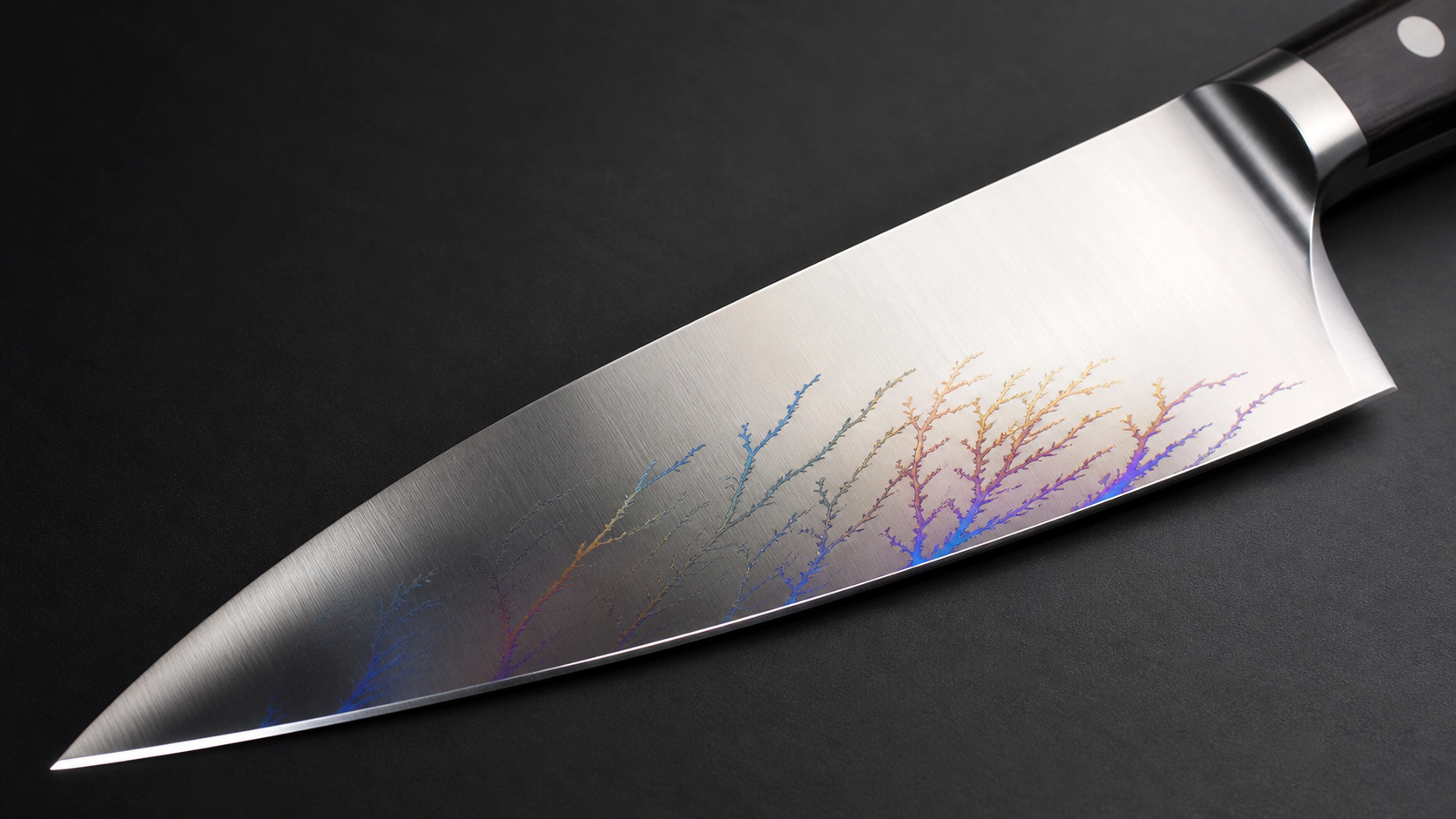
Short answer: MOPA laser color marking is a controllable pulsed fiber laser process that changes the surface of metal. On stainless steel knives, the color is usually not printed ink or paint. It comes from a laser-induced oxide film, surface chemistry or microscopic structures that reflect light as gold, blue, purple or rainbow-like color.
For kitchen knives, steak knives, outdoor knives and gift knife sets, MOPA laser color marking can be used for brand logos, product series marks, decorative patterns, serial numbers and anti-counterfeit details. The benefit is a premium visual effect without ink or stickers. The limitation is that color depends strongly on the steel grade, surface finish and laser settings, so production testing is essential.
What is MOPA laser color marking?
MOPA stands for Master Oscillator Power Amplifier. In a MOPA laser system, the master oscillator creates the seed laser pulse, while the power amplifier increases that pulse to a level that can process a metal surface.
Compared with many fixed-pulse fiber lasers, a MOPA fiber laser gives operators more control over pulse width, frequency, power, scanning speed and hatch spacing. That control matters because color marking is not simply about burning deeper into metal. It is about controlling heat input at the surface.
Ordinary laser engraving removes material to create a visible mark or groove. MOPA laser color marking is closer to controlled surface modification. This is why the term laser etch can be confusing: one supplier may mean shallow engraving, while another may mean low-removal color marking.
Why can stainless steel knives show color after laser marking?
Stainless steel knives can show color after laser marking because the laser creates a controlled oxide film, changes the surface chemistry or forms microscopic structures. When white light hits this modified surface, different wavelengths are reflected, absorbed or interfered with, and the human eye sees color.
Stainless steel resists corrosion because chromium in the alloy helps form a thin passive layer. MOPA color marking uses this surface chemistry. Short laser pulses heat a local area rapidly. If the energy is controlled correctly, the surface is not deeply engraved; instead, a very thin oxide layer forms.
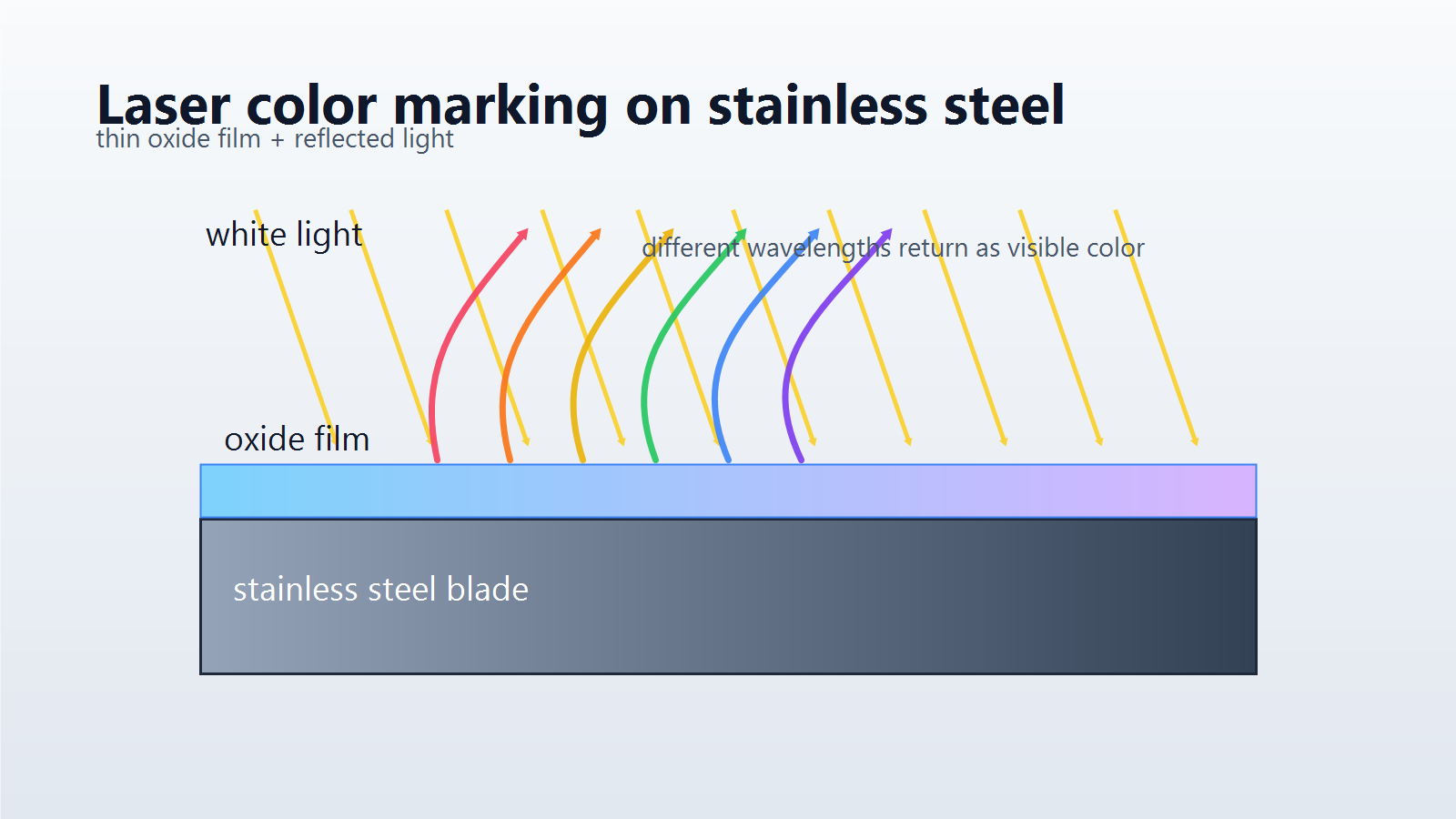
Research on nanosecond laser coloration of stainless steel shows that thin-film interference is only part of the mechanism. Oxide chemistry also matters. Chromium oxides, iron oxides, manganese/nickel-related oxides and spinel structures can all influence the final color. Film thickness, roughness, heat accumulation and scan path also affect the result.
This is why MOPA color marking should not be treated like digital printing. You cannot simply enter an RGB or Pantone value and expect the same output on every knife. It is a material-driven surface process, not an ink process.
How is MOPA color marking different from laser etching or engraving?
In knife sourcing and OEM communication, buyers often use laser etch for several different processes. Technically, color marking, shallow etching and deep engraving have different goals.
| Process | Main effect | Material removal | Typical look | Knife applications |
|---|---|---|---|---|
| MOPA color marking | Changes oxide film, color and surface microstructure | Very low | Gold, blue, purple, rainbow reflection | Blade logos, decorative textures, anti-counterfeit marks |
| Black annealing mark | Forms a dark oxide layer | Very low | Black or dark gray | Model names, steel grade marks, brand logos |
| Laser etching | Lightly removes or roughens surface | Medium | Light gray, white, shallow texture | Serial numbers, batch codes, functional marks |
| Deep laser engraving | Removes more metal | Higher | Visible recessed mark | Permanent lettering, gift knives, thick metal parts |
| Coating removal marking | Removes coating locally | Depends on coating | Exposes base metal or contrast layer | PVD-coated or black-coated knives |
For supplier communication, avoid writing only “laser etch logo.” A better request should include the knife steel, surface finish, logo position, desired color or black mark, food-contact exposure, and durability requirements such as abrasion, salt exposure or dishwasher resistance.
What does the benkrasnow MOPA diffraction grating project show?
The GitHub project benkrasnow/MOPA_Laser_Diffraction_Gratings shows a more advanced laser surface effect: using a MOPA fiber laser to create micron-scale diffraction gratings on polished stainless steel.
The project records an experimental setting where the laser moves at about 300 mm/s while pulsing at 300 kHz, creating a diffraction pattern with about 1 micron spacing on stainless steel. The grating direction is perpendicular to laser motion. The repository also notes test settings such as 300 mm/s speed, 300 kHz frequency, around 19% power, 60 ns pulse width and 0.05 mm line interval as a starting point.
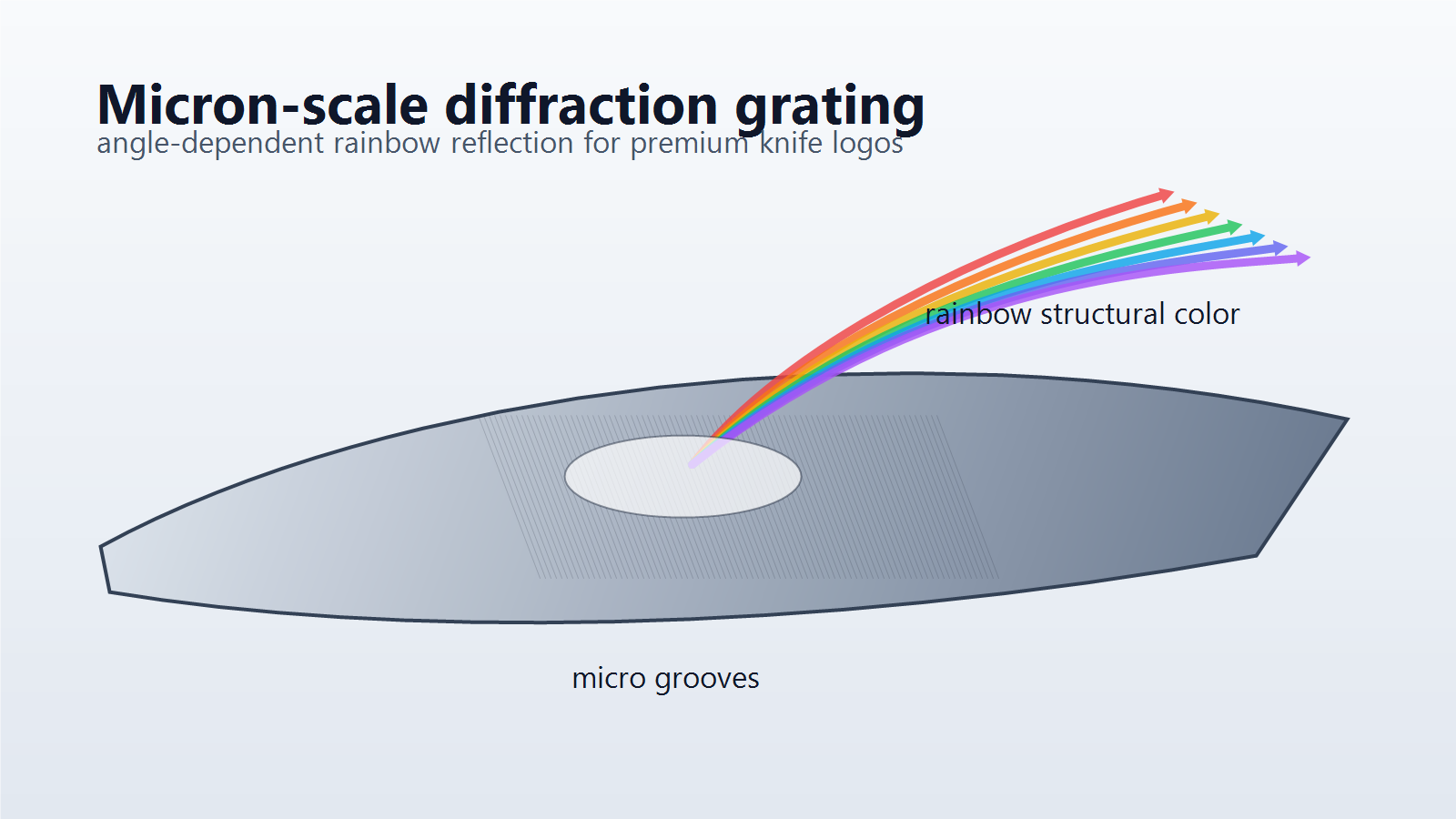
This is different from ordinary oxide-film color marking. A diffraction grating behaves more like the rainbow reflection on a CD, DVD or security label. The surface contains a fine periodic structure that splits light into different colors depending on the viewing angle.
On knives, this effect could be used for premium logos, limited-edition decoration, hidden authentication marks or collectible knife designs. It is more demanding than normal logo marking because it depends heavily on surface flatness, polishing quality, fixture stability and focus consistency.
Where should MOPA color marking be used on knives?
MOPA color marking is best used on visual and branding areas, not on the cutting edge. The edge and primary bevel experience cutting, sharpening and high-friction cleaning, so color films or microstructures are more likely to wear or change.
Suitable knife applications include:
- Brand logos on chef knives, santoku knives and kitchen knives
- Color series identification on steak knives, cheese knives and fruit knives
- Personalized names or dates for gift knives and promotional knife sets
- Private-label decorative themes and limited-edition patterns
- Anti-counterfeit codes on the spine, guard, rivet or metal handle part
- Angle-dependent diffraction textures for display or collector knives
For kitchen knives and table knives, large color areas should avoid high-friction zones. Blade logos can be used, but the marked area should be checked for cleanability, corrosion resistance and durability after repeated washing.
Which knife steels work best for MOPA color marking?
MOPA color marking is most mature on polished stainless steel and titanium. Many studies use 304, 316 or 316L stainless steel, while the knife industry often uses 420, 430, 440C, 3Cr13, 5Cr15MoV, X50CrMoV15, AUS-series steels or high-carbon steels.
These steels differ in chromium, carbon, molybdenum, vanadium and manganese content. Heat treatment and surface finishing also change the laser response. The same laser settings may produce different colors on different blade materials.
For sampling, control these variables:
- Use the same steel grade, heat treatment and surface finish as mass production.
- Build the parameter library on mirror-polished, fine satin or consistent brushed surfaces.
- Remove oil, fingerprints and polishing wax before marking.
- Record power, speed, frequency, pulse width, hatch spacing, focus, fill angle and repeat count.
- Make at least three to five repeat samples for each color and design.
If the blade has PVD, black oxide, sandblasting, stonewashing, colored plating or another coating, treat it as a new material system. Do not reuse bare stainless steel parameters without testing.
Which MOPA laser parameters matter during sampling?
MOPA color marking is not controlled by power alone. The final color and surface behavior come from a combination of heat input, pulse behavior and scanning strategy.
| Parameter | Effect on color and surface | Sampling recommendation |
|---|---|---|
| Average power | Controls total heat input; too high can burn or melt the surface | Increase gradually from a low setting |
| Scanning speed | Changes heating time in each area | Test speed matrices |
| Pulse frequency | Affects pulse spacing and single-pulse energy | Evaluate together with speed |
| Pulse width | Key MOPA variable; affects peak power and thermal action | Test multiple pulse widths for each color |
| Hatch spacing | Controls overlap and coverage density | Avoid excessive heat accumulation |
| Focus position | Changes spot size and energy density | Record whether marking is in focus or slightly defocused |
| Fill angle | Affects texture direction and gloss | Evaluate with blade grain direction |
| Fixture stability | Affects focus and repeatability | Keep blade height and position consistent |
The benkrasnow project settings are useful as an experimental starting point for diffraction gratings, but they are not a universal production recipe. Laser power, lens type, spot size, steel grade and polishing quality all affect the result.
What should be tested before mass production?
Color laser marking can add value to a knife product, but kitchen knives and table knives are high-use products. A good sample photo is not enough. Before mass production, validate appearance consistency, corrosion resistance, abrasion resistance, cleanability and food-contact requirements.
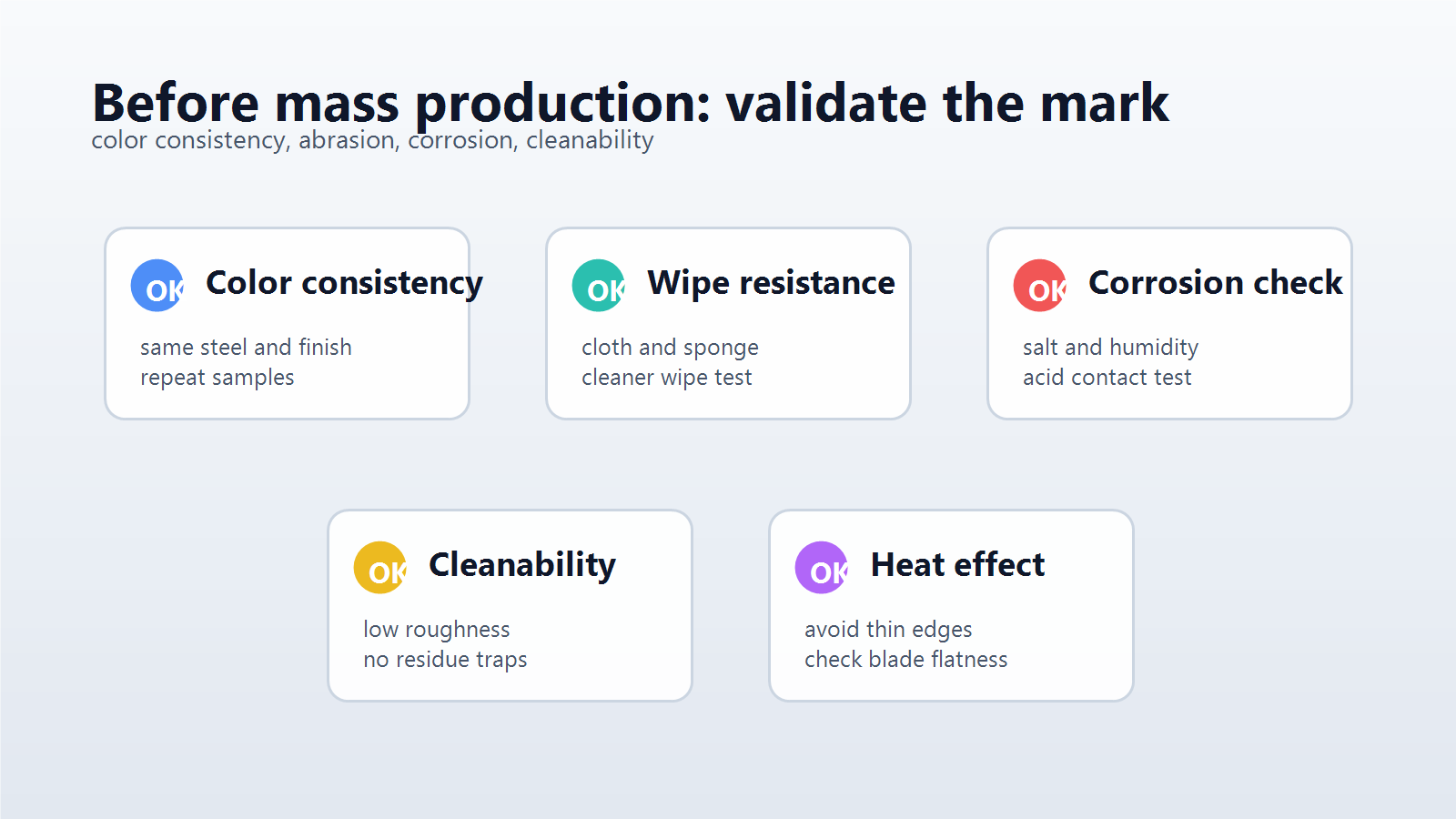
Recommended checks:
- Appearance consistency: color stability across batches, positions and operators.
- Wipe resistance: color change after dry cloth, wet cloth, sponge and kitchen cleaner wiping.
- Corrosion resistance: rust or spotting after salt water, humidity or acidic food exposure.
- Abrasion resistance: wear after packaging, sheath contact and repeated cleaning.
- Cleanability: whether the marked area becomes rough or traps residue.
- Heat effect: whether thin blade areas, flatness or edge hardness are affected.
- Compliance review: if the mark is in a food-contact area, check surface safety for the target market.
Stainless steel corrosion resistance depends on its passive surface condition. Deep engraving, excessive burning or high heat input can damage local protection. For food-contact knives, a low-damage, low-roughness marking route is usually preferred.
How should buyers describe a MOPA color marking project to suppliers?
Use a clear technical request instead of a vague “laser etch logo” request:
We would like to test MOPA laser color marking on stainless steel knife blades without ink, stickers or ordinary printing. The design includes a brand logo, product series name and optional anti-counterfeit texture. The marking position should be near the blade spine, not on the cutting edge. Please make parameter samples using the same steel, heat treatment and surface finish as mass production, and advise on color consistency, wipe resistance, corrosion resistance, abrasion resistance and cleanability testing.
For diffraction grating tests, add:
We would also like to test a micron-scale diffraction grating or angle-dependent rainbow reflection for a limited-edition logo or hidden authentication area. Please evaluate blade polishing, fixture stability, scan-line direction, focus consistency, viewing angle and batch repeatability.
For importers, retailers and private-label brands, the practical sequence is to confirm the knife steel and surface finish first, make MOPA parameter samples second, and only then finalize artwork, packaging and mass-production pricing.
How can Marketvalue support custom knife projects?
Marketvalue / YangJiang Market Value Enterprise Company Limited is a China-based kitchenware, knife and OEM/ODM sourcing partner for B2B buyers. For color laser knife projects, MOPA marking should be treated as a sampling and validation step in the knife customization process, not merely as decoration added at the end.
A practical project workflow is:
- Confirm knife type, steel, heat treatment, surface finish and target market.
- Confirm logo, artwork size, marking position, color direction and food-contact exposure.
- Make MOPA color marking samples or diffraction grating samples.
- Check appearance, wipe resistance, corrosion resistance, abrasion and cleanability.
- Confirm packaging, labeling, QC standards and production requirements.
For importers, chain retailers, supermarkets, hospitality buyers and private-label brands, testing requirements should be written into the sample specification before mass production.
FAQ: MOPA laser color marking on knives
Does MOPA laser color marking rub off?
MOPA color marking is not ink, so it does not peel like ordinary printing. However, the color comes from a surface oxide film or microstructure. Long-term abrasion, sharpening, harsh chemicals or corrosion can still darken, wear or change the color. Wipe and corrosion testing is necessary before production.
Can MOPA color marking be used on the knife edge?
It is not recommended. The edge and primary bevel experience cutting, sharpening and heavy friction. Color marks are more suitable on the blade face near the spine, the spine itself, the guard, rivets or metal handle parts.
Can MOPA color marking match a Pantone color exactly?
Usually not. The color depends on steel composition, oxide film thickness, surface condition and laser parameters. It can approach certain tones through a parameter library, but final approval should be based on physical samples.
Can every stainless steel knife show the same laser color?
No. Different steels such as 304, 316, 420, 430, 440C, 3Cr13, 5Cr15MoV and X50CrMoV15 respond differently. Heat treatment and polishing also matter. Always test on the same material and finish planned for production.
Is black laser marking easier to mass-produce than color marking?
In many cases, yes. Black annealing marks are often easier to control for standard logos, steel grade marks and model names. Color marking has a narrower process window but offers stronger visual differentiation for premium, gift and limited-edition knives.
What is the value of a diffraction grating logo on a knife?
A diffraction grating can create a rainbow reflection that changes with viewing angle, similar to a CD or security label. On knives, it can support premium design, limited-edition branding and hidden anti-counterfeit features, but it requires better polishing and process control.
Conclusion
MOPA laser color marking combines laser processing, surface chemistry and optical effects. It can create colored stainless steel knife logos without ink, and it can also produce angle-dependent rainbow effects through micron-scale diffraction gratings.
For knife brands, importers and private-label buyers, the commercial value is not only visual. The same technology can support product series identification, gift customization, differentiated design and anti-counterfeit marking. But it is not a universal printing method. Color depends on steel grade, heat treatment, surface finish and laser settings.
The safest production path is to confirm the knife material and surface finish first, make MOPA parameter samples, test color consistency, corrosion resistance, abrasion and cleanability, and only then move to artwork approval and mass production. That turns color laser marking from a beautiful effect into a repeatable knife customization capability.
Sources and Further Reading
- Coherent: What is Master Oscillator Power Amplifier (MOPA)?
- Lu et al., Nanosecond laser coloration on stainless steel surface, Scientific Reports, 2017
- Awasthi et al., Understanding the role of oxide layers on color generation and surface characteristics in nanosecond laser color marking of stainless steel, Optics & Laser Technology, 2024
- Schkutow and Frick, Laser color marking of stainless steel, Procedia CIRP, 2024
- benkrasnow/MOPA_Laser_Diffraction_Gratings
- Teutoburg-Weiss et al., Structural colors with embedded anti-counterfeit features fabricated by laser-based methods
- TRUMPF Laser marking booklet
- Laserax: Laser Marking and Etching Stainless Steel