


Choosing Collapsible Colanders for Retail Ranges

Short answer: Choose collapsible colanders by the food-prep task, open and folded footprint, drainage pattern, support at the sink, and how the flexible section joins the rigid parts. Check the exact material of each food-contact component and test a complete sample through repeated opening, draining, cleaning and packing. A catalog photo can show the format; it cannot establish a heat rating or compliance result.
For a retail buyer, "collapsible" is a storage feature, not a complete product specification. A small produce-rinsing basket, a handled colander and a colander-and-bowl set can solve different jobs. Decide what the customer will rinse or drain, where the tool will sit, and how it will be stored before choosing a shape or writing the retail claim.
Define the job and the form
Start with a brief: Is the tool for berries and vegetables, for draining a larger quantity over a sink, or for a compact starter range? Record the intended food, approximate batch size, sink or bowl arrangement, and storage space. A handled format may be easier to position over a vessel; a freestanding basket needs its own stable base; a paired bowl can make a separate storage or prep proposition. These are format choices to test with a sample, not guarantees about a listed SKU.
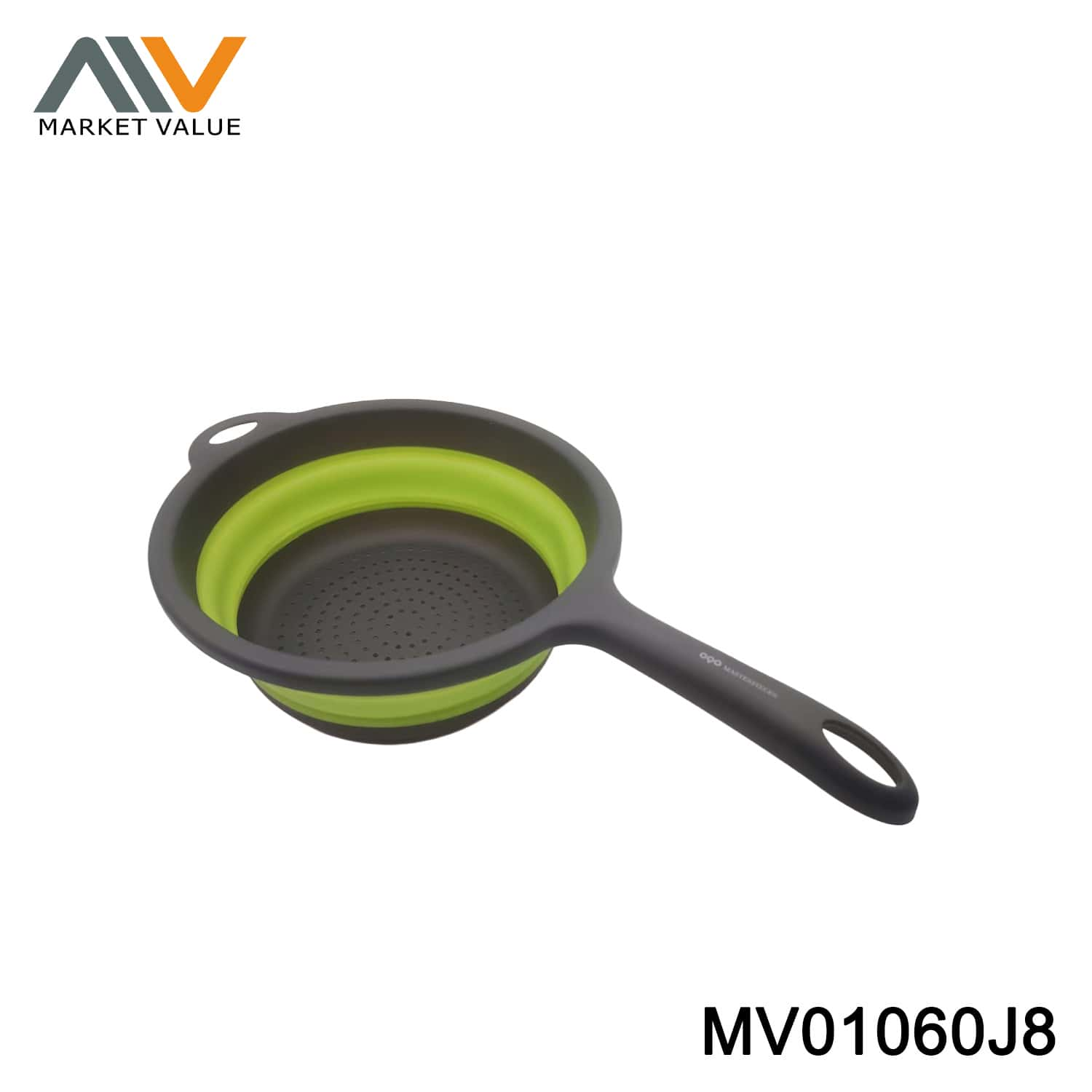
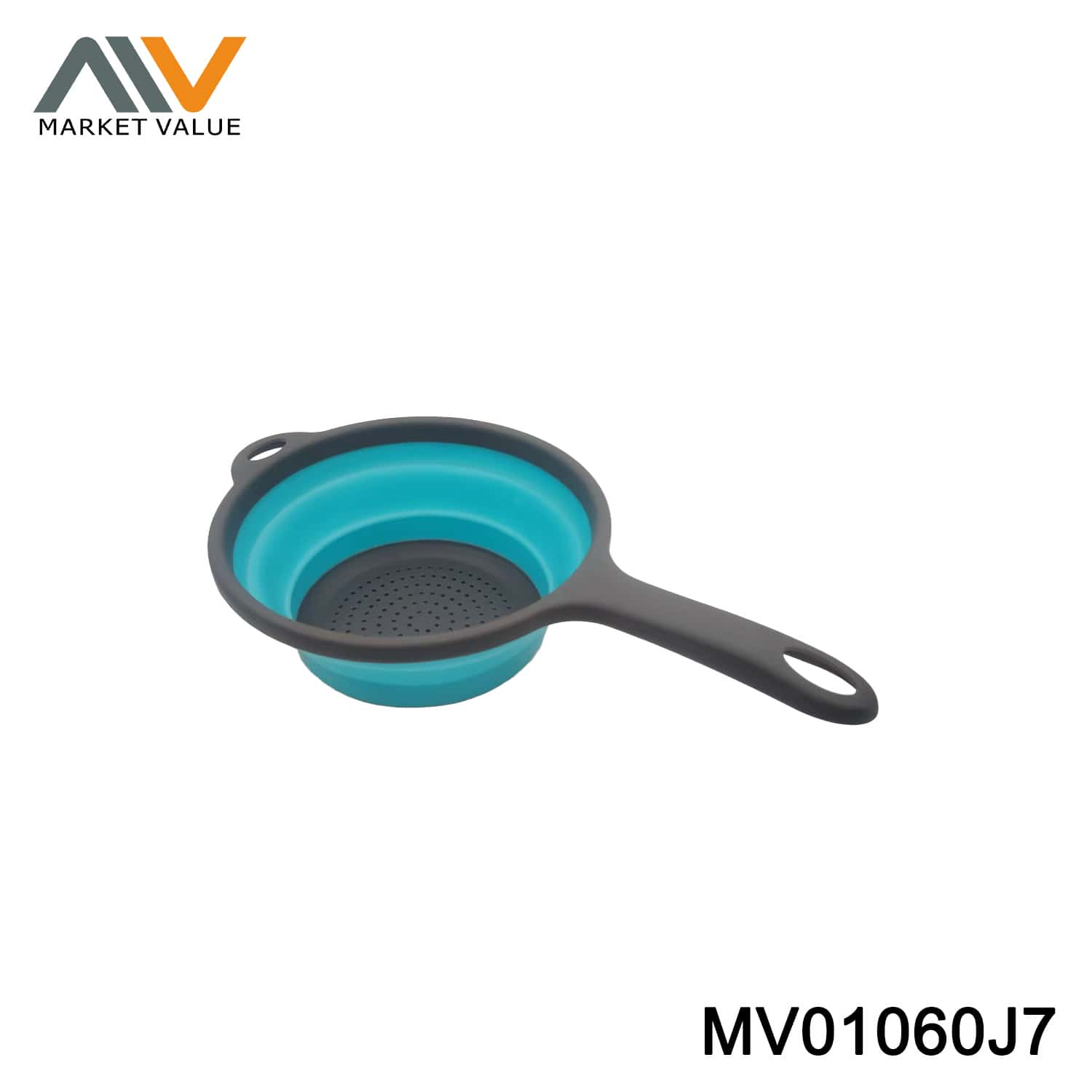
Marketvalue’s current catalog shows a foldable PP and TPR colander with handle, SKU MV01060J8, a 20 cm foldable colander basket, SKU MV01060J7, and a collapsible colander set, SKU MV01060H10. The listings show that the assortment can be built around more than one form. They do not establish that all three share the same polymer, hinge construction, load limit or intended temperature.
Specify both the open and folded state
A nominal diameter alone does not describe a collapsible tool. Ask for the open rim dimensions, usable depth, base footprint, folded thickness and handle reach, with a drawing that defines where each measurement is taken. Compare the folded sample with the planned shelf, drawer or retail package. Compare the open sample with the sink, pot or bowl it is supposed to work with. A compact folded product is of little use if it blocks the sink when open or needs force to stay open.
MV01060J8’s product listing reports a folded height of 3.3 cm, while MV01060J7 is titled as a 20 cm basket. Those are catalog descriptions for those SKUs, not a universal specification for collapsible colanders. Measure the actual approval sample and agree on acceptable variation for the order. If a retail package shows an open and a folded view, confirm that both depict the supplied version.
Review materials at component level
Write a component list for the rim, flexible wall, base, handle, joints, colorants and any parts that can reasonably contact food. The MV01060J8 title names PP and TPR, but it does not identify every component’s composition or prove the finished article’s suitability for every use. The other example titles do not specify a complete bill of materials. Do not substitute "silicone" for a visually flexible part unless the exact material is documented.
For EU-bound kitchenware, the European Commission’s food-contact materials overview explains that kitchenware falls within its food-contact framework and points to general, material-specific and national rules. Its legislation page describes the framework regulation and separate rules for plastics. Ask which requirements apply to the actual materials and intended use in the destination market, and request evidence for the final version. A material name or photo is not a declaration of compliance. Other destinations need their own review.
Heat resistance, dishwasher use and contact with hot food depend on the finished construction and substantiated instructions. If those uses matter to the retail brief, state the proposed conditions and ask for supporting test evidence. Do not add a temperature number or a dishwasher icon to artwork based only on appearance.
Test drainage, support and handling
Inspect the perforation size and distribution with the foods in the brief. Tiny produce can escape through large holes; narrow holes may retain food debris and take longer to clean. Put the sample in the intended position and observe how water leaves the base. Water trapped in a fold, rim or seam affects the cleaning experience even when the main bowl drains well. Compare the tool after a short rinse and after a fuller load; record observations rather than assuming one trial proves performance.
Check stability before and during draining. Does the base sit flat? Can the wall remain open under the agreed test load? Do handles, hooks or rim supports keep the tool where the customer expects? Examine the join between rigid and flexible sections for gaps, sharp edges or movement. These checks should be written against the chosen sample and loading method; no load capacity has been verified for the listed products here.
Fold and reopen the sample repeatedly using a documented count and method chosen for the order. Look for cracking, permanent distortion, loose joins and a wall that no longer stays in its intended position. Wash it as the proposed care instruction says, then inspect folds and perforations for retained debris. An agreed repeat-cycle test is useful for comparing candidates, but it does not replace an appropriate durability or food-contact assessment.
Compare sets, packaging and retail information
The catalog also lists MV01060H10 as a collapsible colander set. A set label is not enough to tell a buyer exactly what each retail package contains. Ask for a contents list and an opened and folded photo of every piece. Confirm whether a bowl, handle or storage accessory is included in the exact offer before using it in artwork.

Choose packaging after the product’s folded dimensions and complete contents are agreed. Check that the fold is not held under damaging compression, that handles and rims are protected, and that the customer can see or understand the product’s open form. The private-label kitchenware packaging brief gives buyers a way to record artwork, contents, barcodes and approval checks. Describe cleaning and permitted uses only after they are supported for the final article and destination market.
Turn the comparison into an approval sample
Request one complete sample of each shortlisted format with its proposed materials, finish, color, package and instructions. Record open and folded measurements, component identification, drainage observations, stability and cleaning results. Photograph the sample in both states with its product code and revision. The kitchenware sample approval checklist explains how to keep a controlled reference when the specification changes.
Before shipment, compare the production lot with that approved reference: the fold action, body shape, holes, joins, packaging and printed use claims should match the agreed version. Use the pre-shipment kitchenware inspection checklist to define the lot, sampling method and defect records. Keep material and regulatory evidence tied to the actual final construction; a matching appearance alone is insufficient.
To compare available formats, browse the Colanders & Food Strainers category. When a shortlist is ready, request a wholesale quote with the target SKU, market, intended use and quantity so the proposed version can be checked against the brief.
Questions buyers often ask
Is a collapsible colander always made of silicone?
No. "Collapsible" describes a function, not a material. One Marketvalue listing names PP and TPR. Confirm the material of every relevant component in the exact product version rather than inferring it from the photo or flexibility.
Is a folded dimension enough to choose the product?
No. Compare open depth, base support, handle reach, drainage and the intended vessel as well. Check the physical sample against the planned pack and storage space.
Can the retail pack claim dishwasher or hot-food use?
Only after the finished article and proposed use conditions have been assessed and the claim has supporting evidence for the destination market. A catalog name or image does not supply that evidence.
What should be kept as the approval reference?
Keep the agreed sample and a versioned specification with component materials, open and folded dimensions, drainage and fold checks, contents, artwork and care instructions. Re-approve affected points when any of those change.
Sources and Further Reading
- European Commission: Food Contact Materials – EU scope for kitchenware and links to applicable rules.
- European Commission: Food Contact Materials Legislation – EU framework and material-specific legislation.