


Wholesale Food Tongs Specification Checklist for Importers

Short answer: A useful wholesale food tongs specification identifies the job the tongs must do, materials at each food-contact point, tip geometry, dimensions, hand feel, opening action, finish, packaging and checks used to accept a sample. A label such as "stainless steel tongs" or "silicone tongs" is a starting point, not a complete purchase specification.
For importers, a small difference in tip shape or spring force can change how a tong handles food. A retail buyer also needs a product that fits the intended pack, cleaning instructions and destination market. This guide turns those decisions into fields a supplier can quote and a buyer can verify. It does not assign one material, temperature rating or test result to every tong.
1. Define the task before choosing a model
Start with the food and setting. Are the tongs for plating pastries, lifting pasta, serving salad, turning food on a hot cooking surface, or handling food at a buffet? Record whether the tool touches hot food, a hot pan, a coated surface or only cold food. Identify the users, such as home cooks, catering staff or a retail gift-set audience.
For each task, write down what the tips must grip without crushing, slipping or piercing the food. A broad, shallow end may help lift flat items. A fork-shaped or serrated end may grip another type of food, but could mark delicate items. A soft tip may suit a surface that needs protection, provided the actual construction and intended-use conditions are confirmed. Test these design tradeoffs with the target food; none establishes a heat limit.
Choose one primary use per proposed SKU. If the assortment needs both delicate serving and firmer gripping, compare two designs instead of making one tong cover incompatible tasks.
2. Record every contact material
Ask for the body, tip, handle, hinge and any coating or overmold to be identified separately. "Stainless steel" does not identify the grade, finish or construction of every component. "Silicone tip" does not describe the metal core beneath it, its attachment or other materials that touch food.
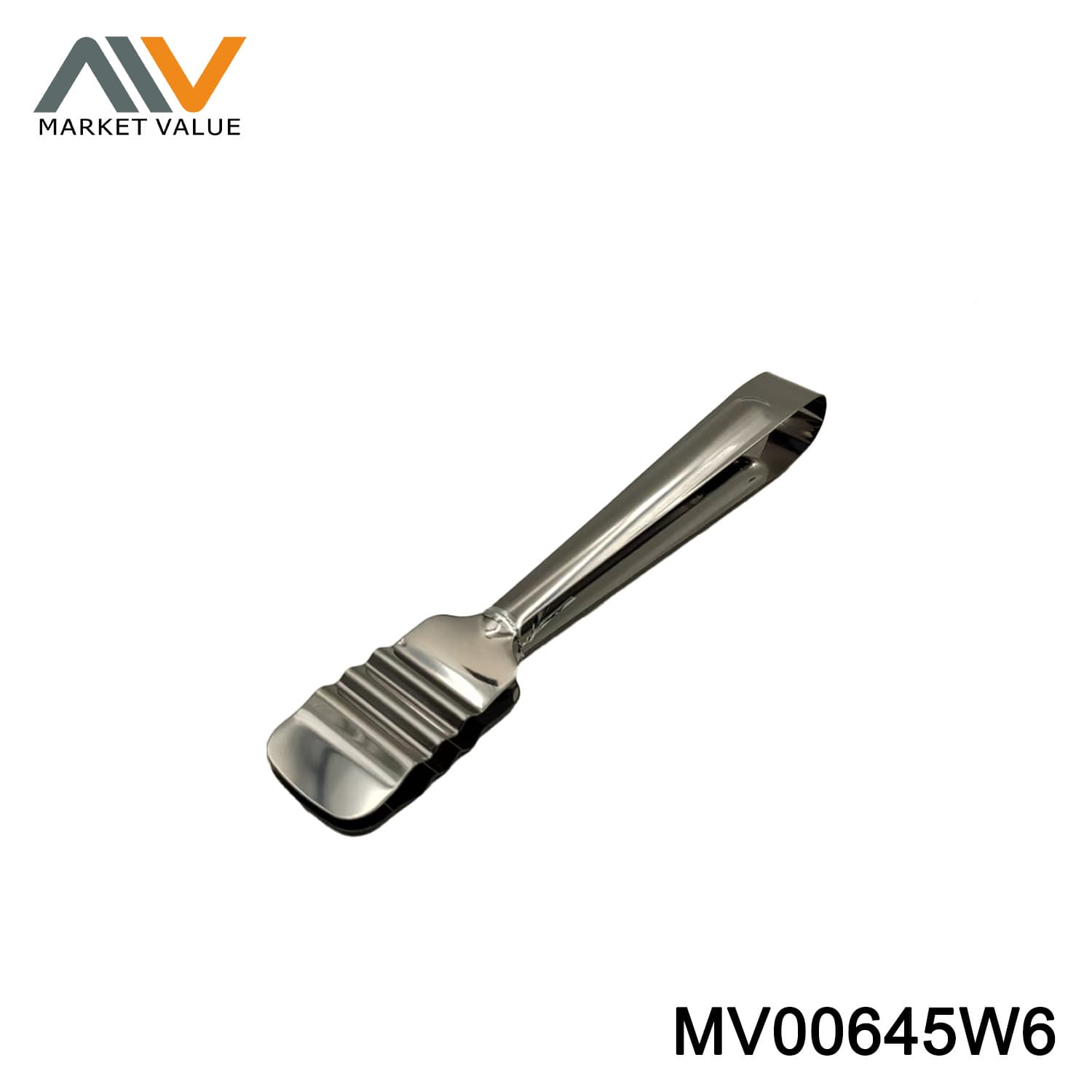
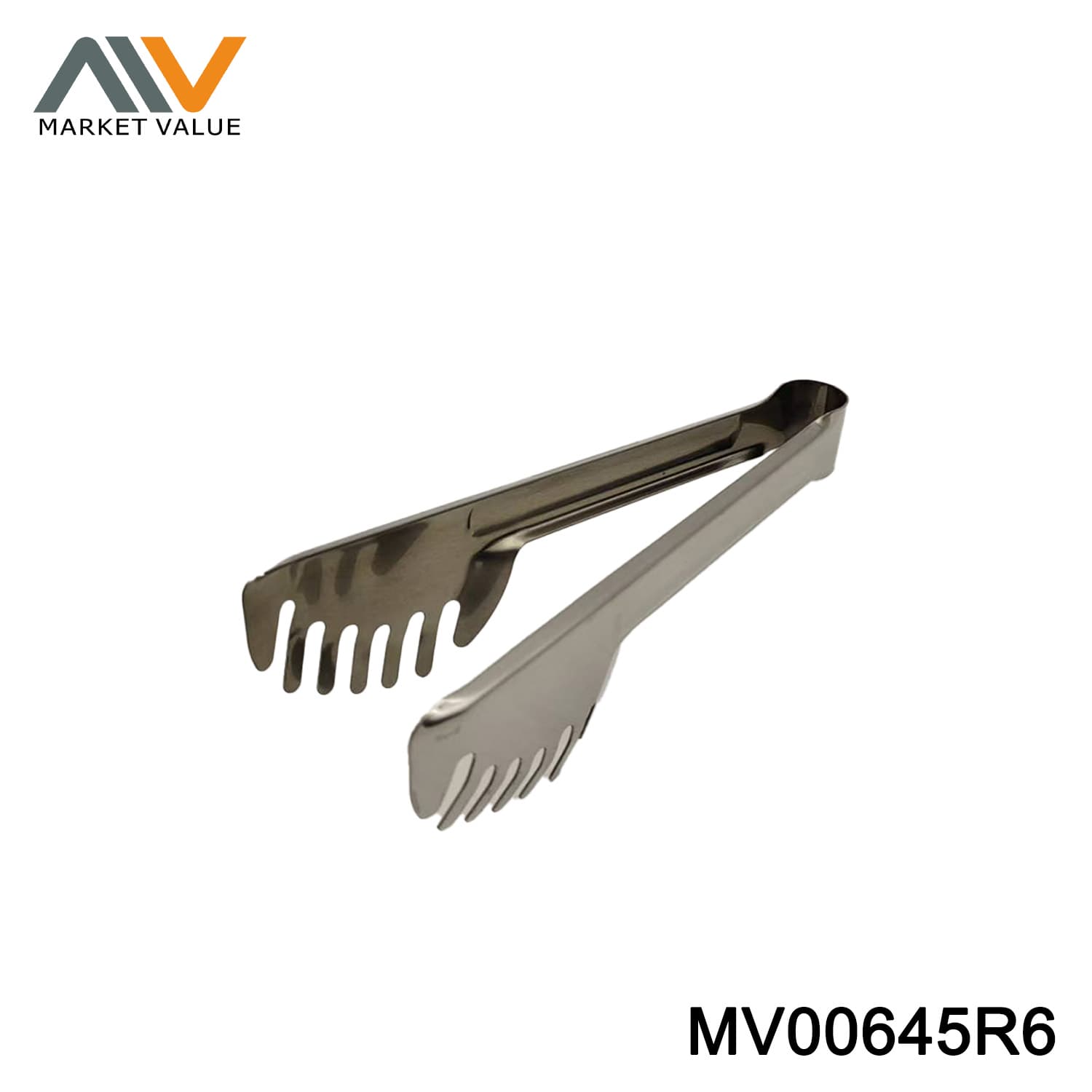
Marketvalue’s live catalog includes SS430 food tongs, SKU MV00645W6, and stainless steel food tongs with serrated tips, SKU MV00645R6. These are different catalog choices, not interchangeable material declarations for all components. Their listings do not by themselves establish compliance or operating temperature. Request a component-level material list for the exact version being ordered.
For the destination market, identify the rules and evidence relevant to the finished food-contact article and its intended use. The European Commission’s food-contact materials overview expressly includes kitchenware and tableware within the EU framework. It points to Regulation (EC) No 1935/2004, good manufacturing practice rules and applicable material-specific or national rules. A catalog tag, grade name or generic "food safe" statement is not a substitute for evidence covering the actual version and market. Ask which components contact food, under what time and temperature conditions, and which documents apply.
3. Specify the tips and gripping behavior
Describe tip width, contact area, edge profile, teeth or serrations, alignment and how far the jaws open. Add a drawing or controlled sample. Set tolerances where fit or function depends on measurement. For a soft tip, specify its coverage, attachment and allowable movement; inspect for lifting, gaps and exposed hard edges on the approved sample.
Use target foods for a simple functional trial. A dry roll, wet pasta and a slippery cooked item make different demands on the tips. Agree the test item and method before comparing suppliers. Record whether food is held securely, damaged or dropped, and whether it releases cleanly. An informal grip trial is not a safety certification.
4. Check the handle, hinge and closing action
The handle must suit the user’s grip and the duration of the job. Compare how the tong feels when held dry, when a glove is worn if relevant, and during repeated opening and closing. Specify any grip insert, hanging loop or storage lock separately; a similar model having one does not mean the quoted model does.
Check that arms meet evenly and return consistently. Look for sharp edges, loose rivets, weak joins, excessive side play and areas difficult to clean. If a locking mechanism is present, define how it engages and releases after repeated use. For a one-piece spring design, define opening force and jaw alignment instead of applying hinge criteria that do not fit that construction.
An agreed sample gives a reference for look and feel, but write down the important features. Our kitchenware sample approval checklist explains how to record a reference sample and changes before production.
5. Put dimensions and use limits in writing
Record overall length, jaw opening, tip width, material thickness where relevant, mass and packaging dimensions in the units your team uses. Define how each dimension is measured. A nominal length in a product title may be rounded or use a different convention; verify the physical sample and order drawing.
For cooking use, ask the supplier to state permitted contact temperature and exposure conditions for the finished tong, including any polymer tip, grip, coating or adhesive. Agree whether a claim concerns brief food contact, continuous use, oven exposure or contact with a pan. Do not infer a temperature rating from the word "silicone," a steel grade or a photograph. If a coating-sensitive cookware surface is part of the use case, test the actual tip against a suitable sample surface under agreed conditions.
Cleaning claims need the same precision. Ask whether the finished item is intended for hand washing or a specified dishwasher cycle, and review instructions that will appear on the retail pack. Test the exact construction and finish under claimed conditions before using a cleaning claim in buyer-facing copy.
6. Agree acceptance checks before ordering
Separate first-sample review from production checks. For the sample, confirm identity, dimensions, finish, function, grip, cleaning instructions, artwork and supplied material or food-contact documents. Keep a controlled reference version so later changes can be identified.
For production, specify checks corresponding to agreed risks: correct SKU and material, dimensions within tolerance, tip alignment, consistent opening action, secure components, smooth edges, acceptable appearance and correct pack contents. Decide how findings are recorded and who approves a change. A failed sample or component issue should prompt investigation against agreed criteria, not a quiet substitution.
Inspection of a finished shipment is a separate decision. Our pre-shipment kitchenware inspection checklist covers lot definition, sampling, packaging checks and disposition. Neither a good prototype nor a catalog photo proves every shipped unit meets the specification.
7. Define retail and transport packaging
State whether each pair is sold loose, on a card, in a sleeve, in a box or in a set. Specify count per inner and master carton, artwork version, barcode placement, required warnings or instructions, and protection for tips and finish in transit. A packing abbreviation in a legacy listing is not a complete brief.
For private label, approve both the finished tong and packed presentation. A sample without final artwork or carton protection cannot settle those decisions. Our private-label kitchenware packaging brief captures artwork, barcode and pack-out details without mixing them into the tool’s performance specification.
A concise food tongs RFQ brief
Send these fields with a product link, drawing or reference photo. Leave unknowns as questions for the supplier instead of treating unconfirmed values as established requirements.
- Buyer and market: destination, sales channel and intended user.
- Use: target foods, serving or cooking task, contact surface, cleaning method and required use limits.
- Construction: body, tip, handle, hinge or spring, coating and other food-contact components; request exact material declarations.
- Geometry: overall length, jaw opening, tip shape, key dimensions, tolerances and measurement method.
- Function: grip trial, alignment, return action, locking action if present, finish and cleaning checks.
- Evidence: documents and testing needed for the finished version and destination market, with agreed time and temperature conditions.
- Presentation: color, logo location, pack format, artwork revision, barcode, instructions and carton protection.
- Approval: sample identification, change-control contact, production acceptance criteria and required records.
Ask suppliers to identify alternative models or materials explicitly. Compare offers on the same approved specification; a unit quote with a different tip, material or pack is not equivalent. For wider commercial fields, use the private-label kitchenware RFQ checklist.
Frequently asked questions
Are stainless steel food tongs always suitable for hot cooking?
No temperature limit follows from that broad label alone. Review the construction of the entire tong, including grips, coatings and joins, and obtain a use limit for the finished item. Test the version that will be sold under the stated conditions.
Do silicone tips automatically protect nonstick cookware?
Do not assume so. Tip coverage, exposed edges, attachment and applied force all matter. Inspect and test the sample against a representative surface, and agree what damage or wear is unacceptable.
What should be compared when two tong quotes look similar?
Compare the task, exact contact materials, length and tip geometry, opening action, finish, approved sample, evidence and packaging. Ask suppliers to list deviations from the same brief. A catalog photo or nominal size cannot establish equivalence.
Can a catalog listing serve as the production specification?
It can identify a model to discuss, but the purchase order should reference an approved version and measurable requirements. Clarify ambiguous fields with a drawing, sample or written answer before production, and control later changes.
Sources and Further Reading
- European Commission: Food Contact Materials: EU framework overview explicitly including kitchenware, with links to Regulation (EC) No 1935/2004, GMP and applicable material-specific or national rules.
- Marketvalue MV00645W6 listing and MV00645R6 listing: current catalog examples and sources for the article images, not compliance or performance evidence.