

Private Label Kitchenware RFQ Checklist: MOQ, Logo, Packaging, Samples and Lead Time

Short answer: A useful kitchenware RFQ should identify the exact product, material, dimensions, quantity, destination market, logo method, packaging, labeling, testing documents, sample requirements, quality checks, trade terms and required delivery date. The clearer these inputs are, the easier it is for suppliers to return quotations that can be compared on the same basis.
A short message such as “Please quote your best price for 3,000 kitchen utensils” does not define one commercial requirement. Two suppliers may respond with different materials, sizes, packaging, inspection assumptions and trade terms, so the lowest number may not represent the lowest comparable cost.
Marketvalue recommends treating the request for quotation as the first version of the product specification. It does not need to be a finished engineering document, but it should state what is fixed, what can be proposed by the supplier and what still requires sampling.
What should a private-label kitchenware RFQ include?
At minimum, include the following sections:
| RFQ section | Information to provide | Why it affects the quotation |
|---|---|---|
| Product identification | Product name, reference SKU, photos, drawings or sample reference | Prevents different products from being quoted under the same generic name |
| Material and construction | Material grade or type, components, thickness, finish and assembly method where relevant | Changes raw-material cost, tooling, performance and testing scope |
| Size and set composition | Dimensions, weight target, capacity and exact pieces in a set | Determines material use, packing size and carton efficiency |
| Order quantity | Initial order quantity by SKU, color and packaging version | MOQ and unit price often apply to each production or artwork combination |
| Destination market | Country or region of sale and intended use | Affects labeling, documentation, testing and packaging requirements |
| Branding | Logo file, placement, dimensions, color and application method | Different logo methods require different setup, artwork and durability checks |
| Retail packaging | Packaging format, materials, print coverage, insert and display requirements | Packaging can change tooling, print setup, unit cost and lead time |
| Carton and logistics | Units per carton, carton marks, pallet needs and delivery destination | Affects freight planning, handling and landed-cost comparison |
| Samples | Stock sample, customized sample or pre-production sample requirements | Clarifies what must be approved before production |
| Quality plan | Critical dimensions, functional checks, defect criteria and inspection stage | Aligns the quote with the buyer’s acceptance standard |
| Commercial terms | Currency, Incoterm, payment expectations and quotation validity | Ensures suppliers are pricing the same responsibility and delivery point |
| Timing | Required sample date, order date and target ship or arrival date | Allows the supplier to check tooling, packaging and production capacity |
If a field is unknown, label it supplier to propose rather than leaving it invisible. That tells the supplier to recommend an option and price it separately.
1. Identify the exact product before asking for MOQ
Start with an existing product URL or SKU when possible. If the product is new, attach clear reference images, a drawing or a physical sample description. State which details must match the reference and which may change.
Generic names are rarely enough. “Knife set,” “cutting board” and “BBQ tool set” each cover many constructions and price levels. The RFQ should answer questions such as:
- Is the request for an existing catalog product, a modified catalog product or a new ODM design?
- Which components are included in the set?
- Which dimensions, weight and appearance details are fixed?
- Which materials or finishes may the supplier propose?
- Is the quoted item intended for retail, food service, gifting or promotional use?
Buyers can use Marketvalue’s current wholesale product catalog to identify starting points before requesting modifications.
2. Specify material, construction and measurable requirements
Material wording should be as precise as the buying decision requires. “Stainless steel,” “wood” or “plastic” may still leave several commercial options open.
Depending on the category, specify or request confirmation of:
- Metal or alloy grade where it matters to the product and market
- Plastic or silicone material type and any supported performance claims
- Wood or bamboo construction and finish
- Coating, plating, polishing or surface treatment
- Product dimensions, thickness, weight or capacity
- Handle construction and joining method
- Color reference, preferably with an approved physical or recognized color standard
- Tolerances for dimensions that affect use, assembly or packaging
Do not copy a material claim from another product because it looks similar. The quotation, sample, product specification and test documentation should refer to the same construction.
3. Give quantities by SKU, color and packaging version
MOQ is not one universal number across a kitchenware program. It may be affected by the product, production process, material purchase, color run, logo method, packaging print run and whether new tooling is required.
Provide:
- Initial order quantity for each SKU
- Quantity for each color or finish
- Quantity for each logo or packaging artwork version
- Expected repeat-order frequency, if known
- Annual volume estimate, clearly marked as a forecast rather than a firm order
- Whether mixed-SKU consolidation is required
Ask the supplier to state the MOQ and price basis for every quoted version. If the requested quantity is below the normal production minimum, ask for alternatives such as a stock color, shared packaging structure, simpler logo method or higher quantity with a better unit price.
This approach is more useful than asking only for the “lowest MOQ,” because it shows which change creates the commercial constraint.
4. Define logo and private-label requirements
Attach vector artwork when available and identify the approved brand version. A logo request should specify:
- Logo placement on the product and packaging
- Maximum dimensions and orientation
- One-color, multi-color or exact color requirement
- Proposed application method, or a request for supplier recommendations
- Surface and finish receiving the logo
- Durability or appearance checks required during sample approval
- Whether country-of-origin or other permanent markings are needed
Possible methods may include laser marking, etching, printing, embossing, debossing or a branded label, depending on the material and product. Do not assume that the same method works equally well on steel, silicone, wood, coated metal and retail packaging.
If the visual result is important, request a customized sample or an artwork proof before mass production.
5. Describe retail packaging as a specification, not a label
“Color box” is not a complete packaging instruction. A packaging RFQ should clarify:
- Packaging format: sleeve, hangtag, blister card, window box, closed color box, gift box or bulk pack
- Packaging material and any requested sourcing claim
- Finished dimensions or maximum shelf footprint
- Print sides, color count and finish
- Product fixation, insert, tie, tray or protective component
- Barcode type and barcode data supplied by the buyer
- Required languages, warnings, care instructions and country-of-origin text
- Retailer-specific labels, price tickets or carton labels
- Drop, transit or shelf-display requirements where applicable
- Master-carton quantity, carton marks and pallet rules
Barcode ownership and data should come from the buyer or the buyer’s authorized standards organization account. The supplier can place and print the code, but should not invent the product identifier.
Environmental or chain-of-custody claims also require evidence. For example, if FSC labeling is requested for paper or wood-based packaging, confirm the applicable supply-chain and artwork requirements before printing rather than adding the logo as a decorative claim.
6. State the destination market and compliance scope
Kitchenware requirements depend on the destination, intended use, materials and surfaces that contact food. Include the country or region of sale and identify whether the product will contact food, hot food, acidic food or repeated-use conditions.
Ask suppliers to list the documentation included in the quotation and to identify any testing that is excluded or priced separately. The RFQ may need to address:
- Applicable food-contact framework for the destination market
- Product-specific material or migration testing
- Labeling and warning requirements
- Packaging and environmental requirements
- Retailer protocols or restricted-substance specifications
- Third-party inspection or laboratory requirements
- Whether reports must cover the finished product, a material, a color or a product family
For EU food-contact products, the European Commission explains the general framework and material-specific legislation. A test report should still be checked against the exact product, material, finish and intended conditions of use. Buyers can also review Marketvalue’s guide on how to read an LFGB test report for metal kitchen tools.
Do not ask a supplier to state that “all products are certified.” Ask which current document supports the specific product being quoted.
7. Separate stock samples, customized samples and approval samples
Use the word sample precisely. There are several different purposes:
| Sample stage | Main purpose | What to check |
|---|---|---|
| Stock sample | Evaluate the basic product direction | Size, weight, function, materials and general workmanship |
| Customized sample | Review requested logo, color, finish or packaging | Branding position, color, process feasibility and appearance |
| Pre-production sample | Confirm the production specification before the main run | Final construction, approved components, artwork and packing method |
| Shipment or production sample | Retain evidence from the production batch | Consistency with approvals and future claim or reorder reference |
The RFQ should state how many samples are needed, where they must be sent, who pays courier charges, which tests will be performed and what approval is required before production.
Keep written approvals and reference images. A casual message such as “looks fine” is harder to use as a production control than an approved specification and clearly identified sample.
8. Define quality checks before comparing prices
A quotation that includes defined quality controls is not directly comparable with one that assumes only a basic visual check.
List the product characteristics that would make the shipment unacceptable. Depending on the item, these might include:
- Incorrect material or component
- Wrong dimensions, weight or set composition
- Sharp burrs, rough edges or unsafe assembly
- Functional failure
- Loose handles, weak joints or poor alignment
- Visible finish, coating, printing or color defects
- Incorrect artwork, barcode, label or carton mark
- Packaging that does not protect or retain the product
Ask when inspections occur and whether a third-party pre-shipment inspection must be allowed. If the buyer uses a specific sampling plan or retailer manual, attach it rather than using the word “standard” without a reference.
9. Ask for a transparent price breakdown
A useful quotation should show what is included. Request separate lines where relevant for:
- Unit price at the requested quantity
- Price breaks at realistic alternative quantities
- Logo or decoration setup
- Tooling or mold charges
- Customized sample charges
- Packaging setup, printing plates or other one-time costs
- Product testing or inspection
- Inner pack, master carton and pallet requirements
- Freight or delivery charges when included
- Taxes or duties only when the agreed delivery term makes the supplier responsible
State the currency and Incoterm, including the named place or port. “FOB price” without a named port is incomplete. The International Chamber of Commerce maintains the official Incoterms rules that define how responsibilities, costs and risks are divided.
10. Separate sample lead time from production and delivery timing
Do not request only “lead time.” Ask suppliers to separate:
- Time to review the RFQ and issue a quotation
- Stock-sample preparation
- Customized-sample development
- Tooling or mold development, if required
- Packaging artwork and proof approval
- Mass-production time after approvals and deposit
- Inspection and corrective-action allowance
- Export preparation
- Transit time to the named destination
Provide the target arrival date, not only the date you hope production will finish. The supplier can then work backward and flag whether sampling, packaging or testing creates a schedule risk.
MOQ, sample cost and production timing must be confirmed in the current quotation. They should not be copied from another item or an old order.
Category-specific RFQ examples
The same RFQ template should be adapted to each category.
Knife sets
For a 15-piece knife set with a pine block, specify the exact piece list, blade material and construction, handle material, block material, finish, logo position, sharpness or functional requirements, retail packaging and any market-specific documentation.
Cutting boards
For an 18 × 12 inch bamboo cutting board, specify dimensions, thickness, bamboo construction, surface finish, edge profile, moisture and warp expectations, care instructions, packaging and applicable food-contact requirements.
BBQ tool sets
For a seven-piece stainless-steel BBQ tool set with wood handles, confirm the piece list, tool dimensions, metal and handle construction, hanging or storage features, logo location, packaging, functional checks and intended market.
Cooking utensil sets
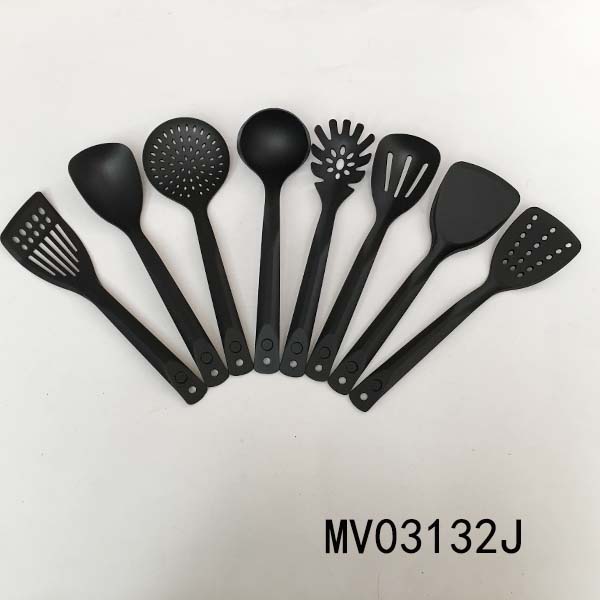
For a nylon or silicone utensil set, confirm every included tool, food-contact material, handle construction, color, supported temperature or care claims, packaging and the documentation required for the destination market.
These examples are product starting points, not fixed commercial offers. Current materials, MOQ, price, sample options, packaging and availability must be confirmed in writing.
Copy-ready kitchenware RFQ template
Use the following template in an email, spreadsheet or sourcing brief:
Buyer and market
- Company and brand:
- Destination country or region:
- Sales channel or retailer:
- Target arrival date:
Product
- Product name and reference SKU or URL:
- Intended use:
- Exact set composition:
- Material and construction:
- Dimensions, weight or capacity:
- Finish and color:
- Required tolerances or functional checks:
Quantity and branding
- Quantity by SKU:
- Quantity by color or artwork version:
- Repeat-order forecast, if available:
- Logo method, placement, size and color:
- Artwork attached: yes/no
Packaging and labeling
- Retail packaging format:
- Packaging dimensions or shelf limits:
- Required languages and warnings:
- Barcode data supplied: yes/no
- Units per inner and master carton:
- Carton marks and pallet requirements:
Compliance and quality
- Destination-market requirements:
- Required reports or tests:
- Retailer protocol attached: yes/no
- Inspection requirement:
- Critical defects or acceptance criteria:
Samples and commercial terms
- Required sample type and quantity:
- Sample delivery address and deadline:
- Currency:
- Incoterm and named place or port:
- Requested price breaks:
- Required quotation validity:
- Required production and shipment timing:
Ask the supplier to list assumptions, exclusions and alternative recommendations. That makes gaps visible before samples or production begin.
Common kitchenware RFQ mistakes
Avoid these recurring problems:
- Requesting a price from one photo without confirming size, material or packaging.
- Asking for a universal MOQ across unrelated products.
- Using “food grade” without defining the material, market or supporting documentation.
- Requesting a logo without artwork, position, dimensions or process requirements.
- Treating a stock sample as approval of a customized production specification.
- Comparing EXW, FOB, CIF and delivered prices as if they include the same responsibilities.
- Leaving barcode, warning and language requirements until packaging is already printed.
- Copying a test report or compliance claim from a similar-looking product.
- Giving only a ship date without allowing time for sampling, artwork, testing and inspection.
- Accepting a quotation that does not state its assumptions and exclusions.
How can Marketvalue support a private-label RFQ?
Marketvalue combines its own manufacturing resources with coordinated sourcing from partner factories. This model supports buyers who need one product category as well as mixed-SKU kitchenware programs.
Support can include product selection, supplier matching, OEM/ODM review, material and finish discussions, logo and packaging coordination, sample review, production follow-up, quality checks and export preparation. Not every catalog item is made in the same factory or supplied under the same terms, so each quotation should confirm the responsible production source and current commercial conditions.
Buyers can review Marketvalue’s OEM/ODM service, learn about B2B sourcing solutions or submit the completed checklist through the wholesale quotation form.
FAQ
What is an RFQ in kitchenware sourcing?
An RFQ, or request for quotation, is a structured request asking a supplier to price a defined product, quantity, branding, packaging, quality and delivery requirement. It should create a comparable basis for supplier responses.
Should I ask for MOQ before sending product details?
You can ask for a preliminary MOQ, but it may change after the supplier reviews the material, color, logo, packaging and tooling requirements. A more useful RFQ requests MOQ by SKU and version.
What files should I attach to a private-label RFQ?
Attach product references or drawings, vector logo artwork, packaging dielines or examples, color references, labeling text, barcode data, retailer manuals and applicable test or inspection requirements.
Is a stock sample enough to approve mass production?
Not when the order changes the material, color, logo, construction or packaging. Use the stock sample to select a direction, then approve the final customized or pre-production specification separately.
Why do two kitchenware quotations have very different prices?
The suppliers may be pricing different materials, dimensions, packaging, quality controls, quantities or trade terms. Compare assumptions and exclusions before comparing unit prices.
Can one RFQ cover several kitchenware categories?
Yes, but list the technical, packaging and quantity requirements separately for every SKU. Use one shared commercial summary for the destination, timing and delivery terms, then attach category-specific specification sheets.
Ready to Send Your Kitchenware RFQ?
Submit your product specifications, target quantity, branding, packaging and destination through the wholesale quotation form. Marketvalue will review the project and confirm the current MOQ, sample plan, quotation basis and production schedule for the selected items.