


The Ultimate Guide to Choosing the Right Kitchenware for Your Restaurant

Short answer: Choose restaurant kitchenware by starting with the menu, production volume, workstations and cleaning system. Then specify each item’s function, material, dimensions, capacity, construction, storage method, maintenance needs and required documentation. The right choice is the product that performs reliably in the intended workflow at a sensible total cost, not simply the item with the lowest unit price.
Restaurant kitchenware includes the smallwares and tools used to prepare, cook, portion, store and serve food. It can cover knives, cutting boards, mixing bowls, measuring tools, tongs, ladles, turners, strainers, containers and many other frequently handled items. Major installed equipment such as ovens, refrigeration, ventilation and commercial dishwashers needs a separate technical and site review.
This guide provides a procurement framework. Local food codes, workplace requirements and operator procedures still determine what can be used in a particular restaurant.
Start with the menu, not a generic kitchenware list
The menu determines which tasks must happen, how often they happen and which tools carry the highest operational risk. A bakery, steakhouse, quick-service kitchen and catering operation should not buy the same combination of smallwares just because a general checklist labels them “essential.”
Before selecting products, document:
- Menu items and preparation methods
- Expected covers, orders or production batches by service period
- Ingredients that require separate handling
- Batch sizes and portion sizes
- Cooking surfaces and equipment already installed
- Number of staff using each station
- Cleaning, sanitizing and drying methods
- Available shelving, wall storage and drawer space
- Whether the operation is dine-in, takeaway, delivery, catering or mixed
- Local regulatory and customer requirements
Convert every menu item into repeatable tasks such as trimming, slicing, mixing, portioning, frying, grilling, plating and storage. Kitchenware should support those tasks without creating unnecessary movement, cleaning bottlenecks or duplicate inventory.
Map restaurant kitchenware to each workstation
A station-based plan is easier to test than one long shopping list.
| Workstation | Typical smallwares | Selection priorities |
|---|---|---|
| Receiving and storage | Containers, scoops, labels, racks and thermometers | Capacity, identification, stackability, cleaning and the applicable storage procedure |
| Cold preparation | Knives, cutting boards, peelers, bowls, measuring tools and strainers | Task fit, separation controls, edge or blade performance, stable work surface and easy cleaning |
| Hot line | Tongs, turners, ladles, spoons, spatulas and cookware | Heat exposure, handle design, length, weight, construction and compatibility with cooking surfaces |
| Baking and pastry | Scales, measuring tools, bowls, scrapers, whisks and trays | Measurement consistency, batch capacity, smooth surfaces and repeatable portioning |
| Grill or barbecue | Long-handled tongs, turners, forks, brushes and trays | Reach, grip, heat exposure, cleanability and safe storage between uses |
| Plating and service | Portion tools, tongs, spoons, trays and flatware | Portion consistency, presentation, speed, durability and replacement availability |
| Warewashing and sanitation | Brushes, racks, bins and drying storage | Compatibility with the cleaning process, drainage, separation and inspection access |
Treat the table as a planning structure, not a fixed product prescription. The operator should approve the final list against the actual menu and kitchen layout.
1. Select knives and cutting boards as a system
Knives and cutting boards affect preparation speed, control, maintenance and separation procedures. Specify them together rather than buying each category in isolation.
For knives, compare:
- Blade type and length for the intended task
- Blade material and construction
- Edge geometry and sharpening plan
- Handle material, shape, grip and joining method
- Overall balance and weight
- Cleaning restrictions and storage method
- Identification or color-coding requirements
- Availability of consistent replacements
A chef knife used for general preparation has different requirements from a boning knife, bread knife, cleaver or utility knife. Ask staff to test a representative sample during realistic preparation tasks before standardizing a model.
For cutting boards, confirm:
- Material and construction
- Usable surface dimensions and thickness
- Resistance to movement on the worktop
- Edge, groove or handle features
- Cleaning and sanitizing method
- Drying and storage arrangement
- Food-separation or color-coding plan
- Inspection and replacement criteria
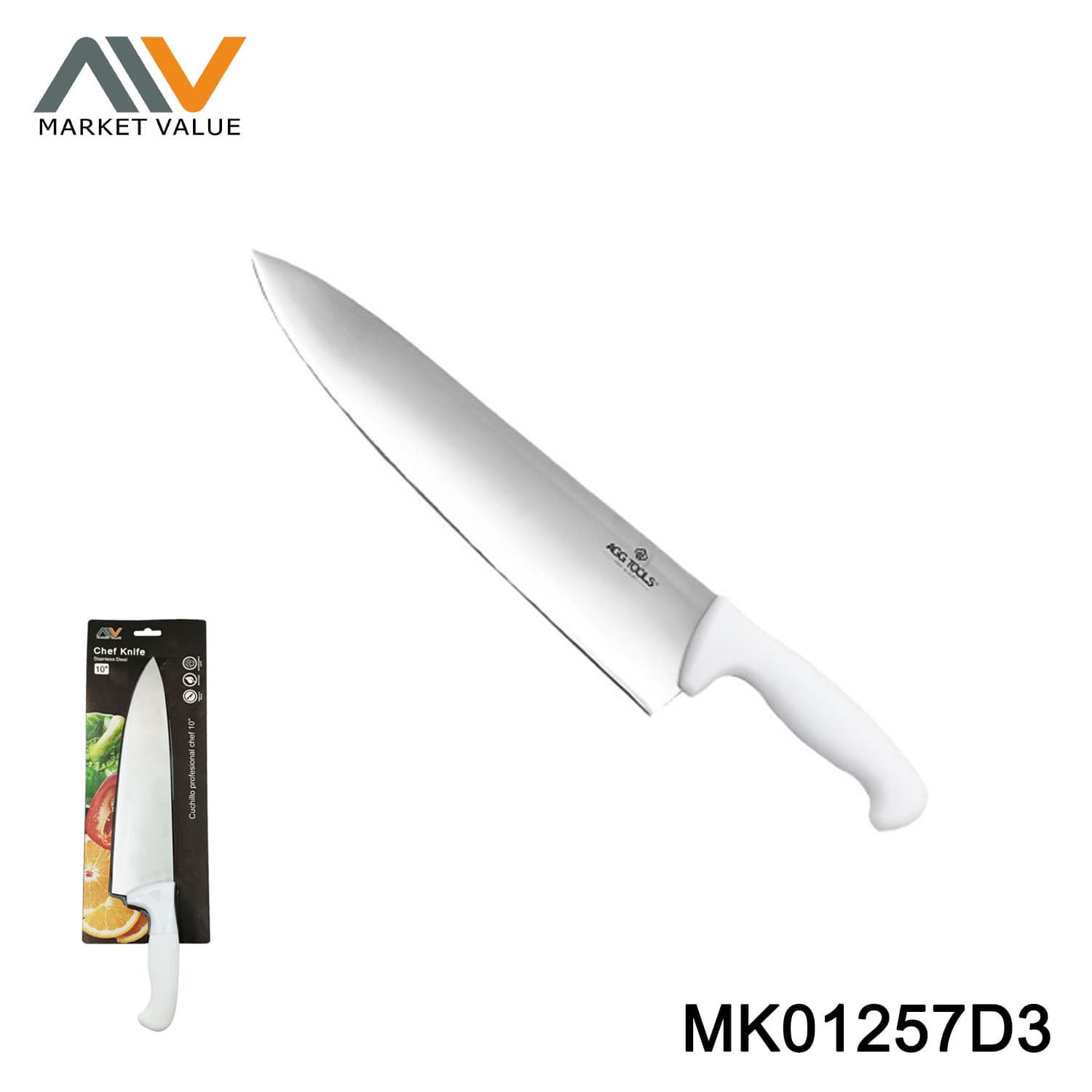
The 10-inch chef knife, SKU MK01257D3 is one catalog example a buyer could use to begin a specification review. Its current material details, edge, handle, packaging, documentation and intended commercial use still need to be confirmed in the quotation and sample approval.
The 28 × 21.5 cm PE cutting board, SKU MV02551V2 provides a useful starting point for discussing board size, thickness, material, surface texture and packaging. Buyers should confirm whether the exact product fits their food-safety procedures and local rules.

2. Match utensils to food, cookware and heat exposure
“Utensils” is too broad for a reliable purchase order. List each function: turning, stirring, serving, skimming, portioning, whisking, scraping or lifting.
For each utensil, specify:
- Working-end material and shape
- Overall length and working dimensions
- One-piece or assembled construction
- Handle material, grip and hanging feature
- Expected contact with heat, oils, acids or abrasive surfaces
- Compatibility with coated, stainless-steel, cast-iron or other cookware
- Cleaning and sanitizing method
- Required portion size where the tool controls serving quantity
Stainless steel can suit many durable utensils, while silicone or nylon may be selected where protecting a cooking surface matters. Material names alone are not enough. Grade, formulation, construction, supported use conditions and documentation should be confirmed for the exact product.
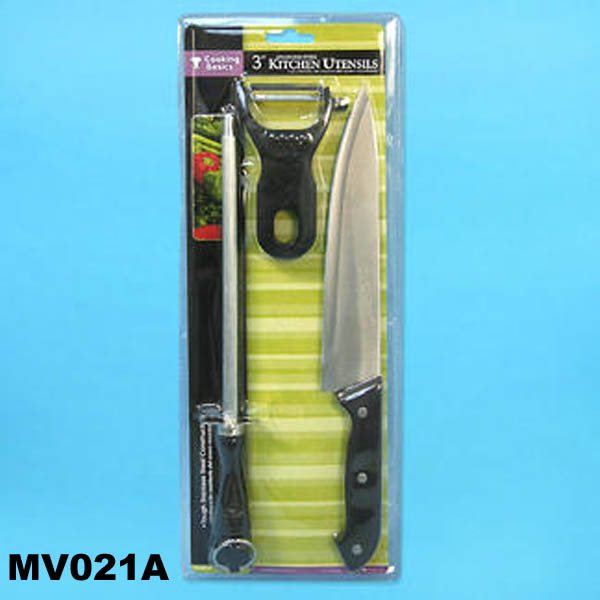
The three-piece stainless-steel kitchen utensil set, SKU MV021A can be used as a visual reference when discussing piece selection, tool length, handle design and packaging. A restaurant buyer should still confirm the exact included tools and whether the specification suits the intended station.
3. Choose materials by use conditions and care requirements
No single material is best for every restaurant tool. Compare materials against the task and the maintenance the team can perform consistently.
| Material | Common kitchenware uses | Questions to verify before buying |
|---|---|---|
| Stainless steel | Knives, utensils, bowls, strainers, flatware and some cookware | Grade, thickness, finish, joints, corrosion exposure, magnetic properties where relevant and cleaning method |
| Aluminum | Some cookware, trays and baking tools | Alloy, thickness, coating or finish, reaction with foods and equipment compatibility |
| Carbon steel or cast iron | Selected pans, woks and specialty cookware | Weight, seasoning, rust prevention, heat source, washing procedure and staff training |
| Silicone | Spatulas, scrapers, grips and selected utensils | Supported use conditions, construction, stiffness, staining and documentation for intended food contact |
| Nylon or other plastics | Utensils, boards, containers and measuring tools | Polymer type, heat exposure, wear, staining, cleaning process and food-contact documentation |
| Wood or bamboo | Selected handles, boards and service items | Finish, moisture exposure, drying, cracking, local rules and replacement criteria |
Avoid vague phrases such as “food grade” without supporting detail. The buyer should identify the destination market, food-contact conditions and required reports or declarations. Documentation for a similar-looking product is not automatically evidence for the quoted item.
4. Confirm dimensions, capacity and equipment compatibility
A product can be well made and still be wrong for the workstation. Check dimensions against the people, equipment, containers and storage locations that will surround it.
Measure and record:
- Worktop depth and available preparation area
- Drawer, rack and shelf dimensions
- Pot, pan, tray and container sizes
- Cooking-surface and oven compatibility
- Utensil reach for deep pots, grills or serving vessels
- Bowl and container capacity for actual batch sizes
- Doorway, sink and dish-rack clearances where relevant
- Stacking height and storage footprint
For cookware, verify the heat source and any induction requirement. For containers, confirm whether lids, racks and labels remain compatible across sizes. For service tools, test the portion size rather than relying only on an overall length.
5. Calculate quantities from workflow and turnaround
Do not use one universal “pieces per seat” rule. Required quantities depend on simultaneous stations, peak demand, washing turnaround, menu complexity, breakage, off-site events and access to replacements.
A practical calculation starts with:
- The number of active stations using the item at the same time.
- The number required at each station during peak service.
- Items temporarily unavailable because they are being washed, dried or inspected.
- A controlled reserve for damage, loss or an unexpected production peak.
- Lead time for replenishment.
Record the reason for every reserve quantity. Excess inventory consumes storage and makes condition checks harder, while too little stock encourages unsafe substitutions and slows service.
6. Test ergonomics during real tasks
Catalog dimensions do not show how a tool feels during repeated use. A sample review should involve the people who will use and clean the item.
Check:
- Grip security with dry and wet hands
- Handle diameter, shape and surface
- Balance and wrist position
- Tool weight during repeated movements
- Reach around hot surfaces
- Control when lifting or portioning food
- Sharp edges, burrs, loose parts or uncomfortable joints
- Whether gloves change grip or control
Ergonomic approval should be tied to a defined task. A heavy tool may feel acceptable in a short sample review but become tiring during a full service period.
7. Design for cleaning, inspection and storage
Restaurant kitchenware should fit the operation’s written cleaning and sanitizing procedures. Ask whether the item can be fully inspected and cleaned, especially around seams, joints, hollow handles, textured surfaces and removable components.
Confirm:
- Manual-wash or machine-wash suitability
- Cleaning chemicals and temperatures used by the operation
- Disassembly requirements
- Drainage and drying position
- Whether the product traps food or water
- Storage that protects clean items from contamination
- Inspection criteria for cracks, chips, corrosion, deep cuts or loose parts
- A clear process for removing damaged items from use
The US Food and Drug Administration publishes the FDA Food Code as a model for safeguarding public health in retail and food-service operations. Adoption and specific requirements vary by jurisdiction, so restaurant operators should follow their local regulatory authority.
NSF also maintains food equipment standards covering sanitation-related aspects of commercial food equipment. Whether a standard or certification is required depends on the product, jurisdiction, buyer and intended use.
8. Compare total cost, not only unit price
The lowest purchase price can become expensive if the item fails early, slows preparation, requires unusual maintenance or cannot be replaced consistently.
Compare quotations using:
- Unit price at the same specification and quantity
- Expected service conditions and warranty terms, if offered
- Sharpening, seasoning or other maintenance needs
- Cleaning labor and process compatibility
- Storage accessories or racks
- Replacement availability and specification consistency
- Sample, testing, inspection and freight costs
- Packaging volume and damage protection
- Downtime or retraining caused by changing models
Avoid assigning an unsupported lifespan during procurement. Instead, create an inspection log after installation and use actual replacement data from the restaurant to improve future buying decisions.
9. Standardize core items and control substitutions
Standardization helps training, storage, portion control and replacement. Create an approved-item list with the SKU, specification, supplier, sample reference and acceptable alternative.
When a supplier proposes a substitution, review what changed:
- Material or material grade
- Dimensions, thickness, weight or capacity
- Handle and joint construction
- Finish, coating or color
- Packaging and labeling
- Food-contact documentation
- Cleaning limitations
- Price, MOQ and lead time
A similar appearance does not make two products operationally equivalent. Approve substitutions through the same sample and documentation process used for the original item.
10. Request samples and product-specific documentation
For high-use or safety-sensitive tools, request a representative sample before placing a large order. The sample review should use a checklist linked to the purchase specification.
Ask the supplier to confirm:
- Product name, SKU and revision
- Material and construction
- Dimensions, weight and capacity
- Intended use and supported use conditions
- Cleaning and care instructions
- Current food-contact or other required documents
- Packaging, carton quantity and labeling
- MOQ, quotation validity and production timing
- Quality checks and inspection access
- Process for approving changes after the order
For buyers preparing a multi-category request, Marketvalue’s private-label kitchenware RFQ checklist provides a structured format for materials, branding, packaging, samples, quality requirements and commercial terms.
Restaurant kitchenware purchase worksheet
Use one row per item or SKU.
| Field | Information to record |
|---|---|
| Restaurant and station | Location, concept and workstation |
| Menu task | Exact preparation, cooking, portioning or service task |
| Product | Item name, reference URL or SKU |
| Specification | Material, construction, dimensions, capacity, finish and color |
| Compatibility | Cookware, heat source, rack, container, dishwasher or storage fit |
| Quantity | Active use, wash-cycle allowance and controlled reserve |
| Cleaning | Method, chemicals, temperature limits, disassembly and drying |
| Quality | Functional checks, defect criteria and inspection stage |
| Documentation | Destination-market and buyer requirements |
| Commercial | MOQ, unit price, samples, freight basis and lead time |
| Approval | Responsible reviewer, sample reference and approval date |
Common restaurant kitchenware buying mistakes
Avoid these recurring problems:
- Buying a generic opening list before mapping the menu and stations.
- Choosing by appearance without checking dimensions, construction and cleaning.
- Using “stainless steel” or “food grade” as the complete specification.
- Assuming a household or retail-packaged item is automatically suitable for restaurant use.
- Ignoring storage, drying and replacement space.
- Ordering one quantity rule for every type of restaurant.
- Comparing prices based on different materials, sizes, packaging or trade terms.
- Approving a sample without recording its SKU and specification.
- Accepting a compliance document that does not cover the quoted product.
- Failing to keep approved alternatives for frequently replaced items.
How can Marketvalue support restaurant and hospitality buyers?
Marketvalue supplies kitchenware to B2B buyers, including hospitality and restaurant-supply customers. Its catalog covers kitchen tools, knives, cutting boards, BBQ tools, tableware, storage products and related categories.
Support can include product selection, sample review, supplier coordination, OEM/ODM discussion, packaging, quality requirements and export preparation. Suitability, MOQ, pricing, documentation and production timing must be confirmed for the selected SKU and destination market.
For grill or outdoor-service programs, the seven-piece stainless-steel BBQ tool set with wood handles, SKU MB00025B6 illustrates why intended use matters: buyers should evaluate tool length, handle material, cleaning, storage and heat exposure rather than choosing only by the number of pieces.
Buyers can review the wholesale kitchenware catalog, learn about B2B sourcing support and send a station-by-station product list through the wholesale quotation form.
FAQ
What kitchenware does a restaurant need first?
Start with the tools needed to execute the opening menu safely and consistently at each workstation. Prioritize high-frequency preparation, cooking, portioning, storage and cleaning tasks before adding specialty items.
What is the best material for restaurant kitchenware?
There is no universal best material. The correct choice depends on food contact, heat, cookware surface, cleaning method, weight, maintenance, local requirements and the exact product construction.
How many utensils should a restaurant buy?
Calculate quantities from simultaneous station use, peak service, washing turnaround, controlled reserves and replenishment lead time. A fixed pieces-per-seat formula does not fit every concept.
Can household kitchenware be used in a restaurant?
Do not decide from the retail label alone. Confirm that the item’s construction, cleanability, supported use conditions and documentation meet the operator’s procedures and local requirements.
Should restaurants request samples before ordering?
Samples are useful for checking dimensions, grip, balance, function, cleaning, storage fit and workmanship. Record the approved sample and specification so production and future replacements can be compared with the same reference.
What should a restaurant kitchenware quotation include?
It should identify the exact product, material, dimensions, quantity, packaging, documentation, quality checks, samples, price basis, MOQ, trade term and production timing. Ask the supplier to list assumptions and exclusions.
Planning a Restaurant Kitchenware Program?
Send your menu concept, station list, required quantities, destination market and cleaning requirements through the wholesale quotation form. Marketvalue will review suitable product options and confirm the current specification, MOQ, samples, documentation and production timing.